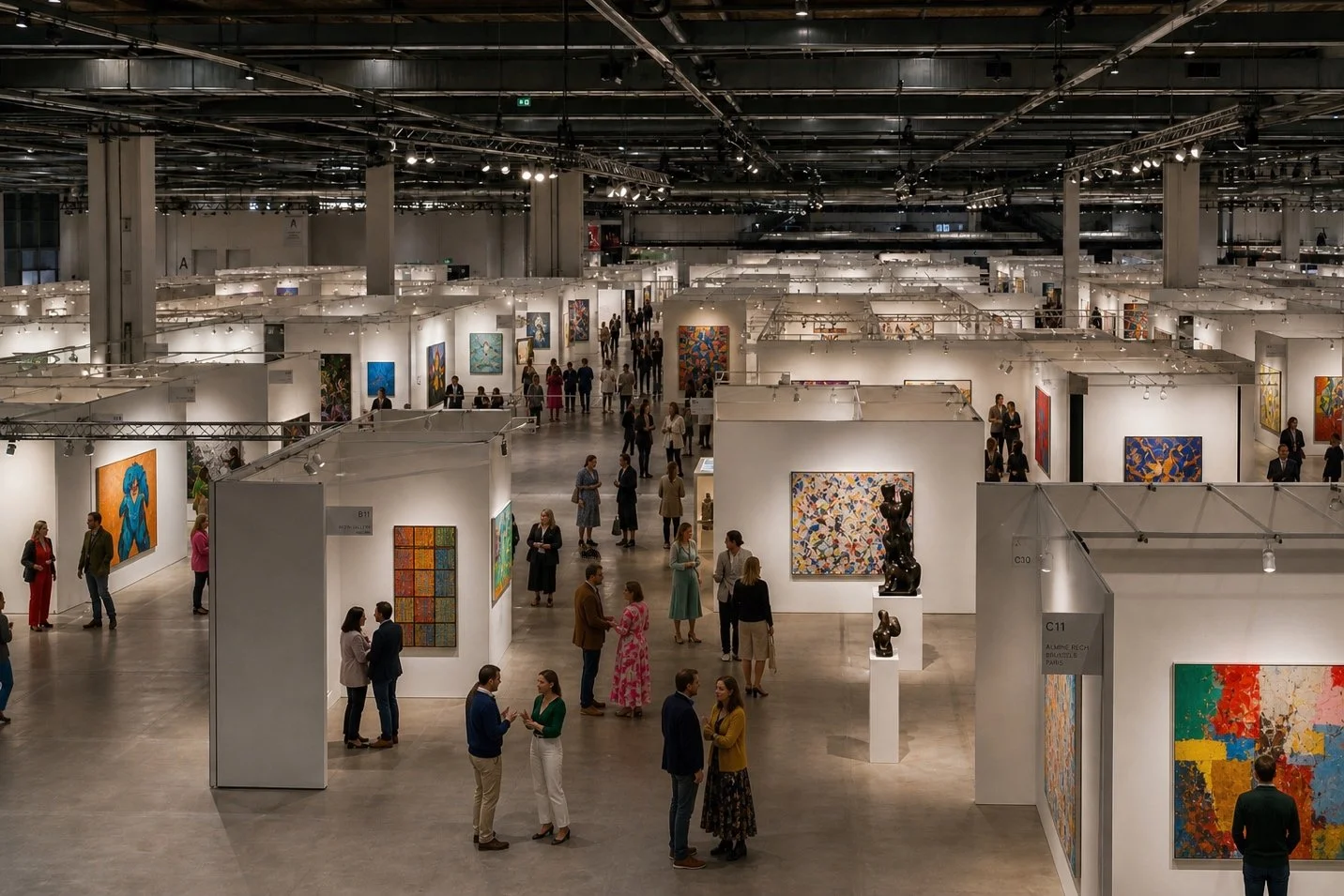
What is Blue Chip Art?

All art holds some form of value, but certain works carry a deeper combination of cultural significance, provenance, and market recognition. These are often works by established artists whose relevance has been recognized for enduring quality, and whose strongest examples continue to command sustained collector demand.
At the very top of this global market sit artists whose significance extends beyond specialist circles—names like Andy Warhol, John Chamberlain, and Jackson Pollock. These cultural behemoths have created works backed by institutional recognition, sustained collector demand, and enduring relevance. These qualities define what is often known as blue chip art.
This article will discuss what blue chip art is, what makes an artist blue chip, and why this category continues to attract discerning collectors seeking cultural significance, market depth, and long-term value.
What Does Blue Chip Art Mean?
Blue chip art is a term used to describe work from an artist with an established reputation within art history, the wider market, and society. These works are typically museum-quality, meaning they are of a calibre associated with major institutional collections, significant exhibitions, and serious art-historical attention. They are often held in prominent private collections, exhibited by leading museums, or traded through the upper tiers of the secondary art market.
The term “blue chip” is borrowed from financial markets, where blue chip stocks are associated with established companies, strong market confidence, and relative long-term stability.
Although similar, comparing blue chip art to financial markets is limiting. Art is not a standardized asset, meaning individual pieces hold value differently depending on factors that can’t be easily reduced to an artist’s name or an auction valuation. Medium, date, condition, provenance, subject, rarity, and the work’s place within the artist’s broader practice all contribute to its significance.
Blue chip status, therefore, should be understood as a starting point for evaluation rather than a conclusion.
What Makes an Artist Blue Chip?
Blue chip status applies to a selective group of artists whose reputations have been tested over time and recognized for their enduring quality. The category is not limited to a handful of names; across periods and markets, it may include hundreds of artists.
Even so, it remains highly selective when viewed against the wider artist universe. This recognition is typically built through a combination of museum representation, significant exhibitions, art-historical research, sustained collector demand, and a meaningful presence in the global secondary market.
The strongest examples of blue chip artists tend to share characteristics such as:
Historical relevance: Their work contributes to a movement (such as Warhol’s Pop Art movement), new visual languages, or helps define a period of art history.
Institutionally recognized: The works of these artists are usually held by museums, included in retrospectives, or supported by foundations, estates, and catalogues raisonnés.
Market depth: These artists have a strong base of serious collectors, dealers, institutions, and auction houses that engage with their work over time.
Context for comparison: A blue chip artist’s body of work is often well-documented, allowing buyers to compare individual pieces by period, medium, importance, exhibition history, and provenance.
Does Price Alone Define Blue Chip Art?
Although price is usually one of the most visible areas of the contemporary art market, it rarely offers a complete measure of quality. High artwork prices can reflect many things: scarcity, competition, fashion, or the presence of a particularly motivated buyer. It can also reflect genuine importance from an art history perspective. The difficulty comes from knowing the difference.
Blue chip art should therefore not be understood with auction headlines alone. A work may command a high price without being among the strongest examples of an artist’s portfolio. Equally, certain historically relevant works may remain underappreciated because they sit outside the most visible areas of market demand.
Well-considered acquisitions begin with a more fundamental question: why does this work matter? The answer may lie in its period, subject, provenance, rarity, condition, exhibition history, or place within the artist’s wider practice. These factors help determine whether a work has the depth to remain meaningful beyond the moment of acquisition.
Examples of Blue Chip Post-War Artists
Many of the most recognizable blue chip artworks and artists are associated with the Post-War period, a category that continues to occupy a central position in art collecting. This period includes artists whose work has shaped movements such as abstraction, Pop Art, Conceptualism, Minimalism, and other major developments of the second half of the 20th century.
Within Post-War and contemporary collecting, some of the most well-established blue chip artists include:
John Chamberlain
Lee Ufan
Kazuo Shiraga
Yayou Kusama
Georg Baselitz
Richard Prince
Jackson Pollock
Mark Tobey
Anselm Kiefer
Helen Frankenthaler
Christopher Woold
William DeKooning
Even at the pinnacle of the art world, an artist’s name alone isn’t always enough. A minor work by a major artist might not carry the same significance or value as a defining work from a central period. Beyond this, a painting may require a different lens for evaluation than a print or sculpture.
David Hockney
For example, David Hockney’s Portrait of an Artist (Pool with Two Figures) is significant not only because it is by Hockney, but because it brings together several of the artist’s most recognizable conceptual and visual concerns: the pool motif, the double portrait, California light, and the emotional architecture of looking.
When it was sold at Christie’s in 2018 for $90.3 million, the price reflected the work’s position within Hockney’s wider practice, not just authorship.
Roy Lichtenstein
Similarly, Roy Lichtenstein’s Nurse is much more than a piece of Pop Art from a famous artist. It belongs to one of the most recognizable areas of his early Pop Art practice, bringing together the comic-book source imagery, Ben-Day dots, bold outlines, and heightened emotion that came to define his visual language. Its provenance, exhibition history, and position within Lichtenstein’s sought-after “girl” paintings all contribute to its significance.
Its 2015 sale for $95.365 million reflected the strength of demand for rare, major examples from one of Lichtenstein’s defining periods across the global art market.
Jean-Michel Basquiat
Jean-Michel Basquiat’s Untitled from 1982 offers another instructive example. Its sale at Sotheby’s in 2017 for $110.5 million reflected the strength of Basquiat’s market, but also the particular importance of the work’s date, scale, imagery, and position within one of the artist’s most closely studied years.
These examples are useful because they show that blue chip value is rarely created by reputation alone. In each case, the work’s particular importance (its date, subject, scale, provenance, rarity, or place within the artist’s practice) is central to how it has been received.
Why Specific Works Matter in the Blue Chip Art Market
Even if an artist is blue chip, their body of work will vary in quality, importance, and market reception. Certain periods will be more significant than others for an artist’s practice. Similarly, certain subjects will be more associated with the artist’s lasting contributions, making them more sought after and valuable. A buyer considering a work by a blue chip artist should ask a series of questions before buying:
Where does the work sit within the artist’s development?
Is it from a recognized period, or does it sit at the edge of an artist's most significant body of work?
Is the subject central or peripheral?
Is the medium especially relevant?
Is the work in good condition?
Has it been exhibited, published, or held in significant collections?
Is the provenance clear?
Are comparable works available, and if so, how does this example stand apart?
These questions shape the confidence behind an acquisition and the value a work may hold over time. A recognized name may provide context, but the work itself still requires careful evaluation.
Comparing Blue Chip Art to Faster Moving Markets
Blue chip art is occasionally contrasted with faster-rising areas of the contemporary market, where prices can move quickly through a combination of collector demand, gallery support, institutional visibility, and auction momentum. Terms such as “red chip art” are sometimes used to describe this kind of market activity, although the phrase is less established than blue chip art.
The distinction is most apparent in the extent to which an artist’s reputation and market have been tested over time. Blue chip artists typically have a deeper foundation of museum representation, art-historical research, sustained collector demand, and repeat market engagement.
Faster-rising markets can attract considerable attention, but they often carry greater uncertainty and are more sensitive to shifts in demand. For buyers, the question is less about which label applies and more about the evidence behind the work: its quality, context, provenance, and long-term relevance.
Why Discerning Buyers Acquire Blue Chip Art
Blue chip art continues to attract discerning buyers because of its cultural depth, established quality, and market maturity. For many, the appeal lies in owning works of significance—art that is rewarding to live with, expressive of a point of view, and supported by a more established basis for long-term value retention.
It typically offers clearer context than more speculative areas of the market. Established artists may have a deeper record of comparable sales, broader art-historical research, and more consistent demand. While this does not remove risk, it can give buyers a more informed basis for assessing quality, value, and long-term relevance.
The objective is not necessarily to become a collector, but to acquire meaningful works with confidence. That means sourcing works that can withstand scrutiny, retain relevance, and continue to reward engagement beyond the immediate moment.
Is Blue Chip Art a Good Investment?
Blue chip art is often discussed in investment terms, but it should not be viewed as a conventional financial product. Art markets are not perfectly liquid; values rise and fall, and individual works vary considerably. Costs such as insurance, storage, shipping, conservation, taxes, and transaction fees can also be material.
The more useful question is not whether blue chip art is a “good art investment” in general. It is whether a particular work represents enduring quality at an appropriate price, within a structure that gives the buyer confidence.
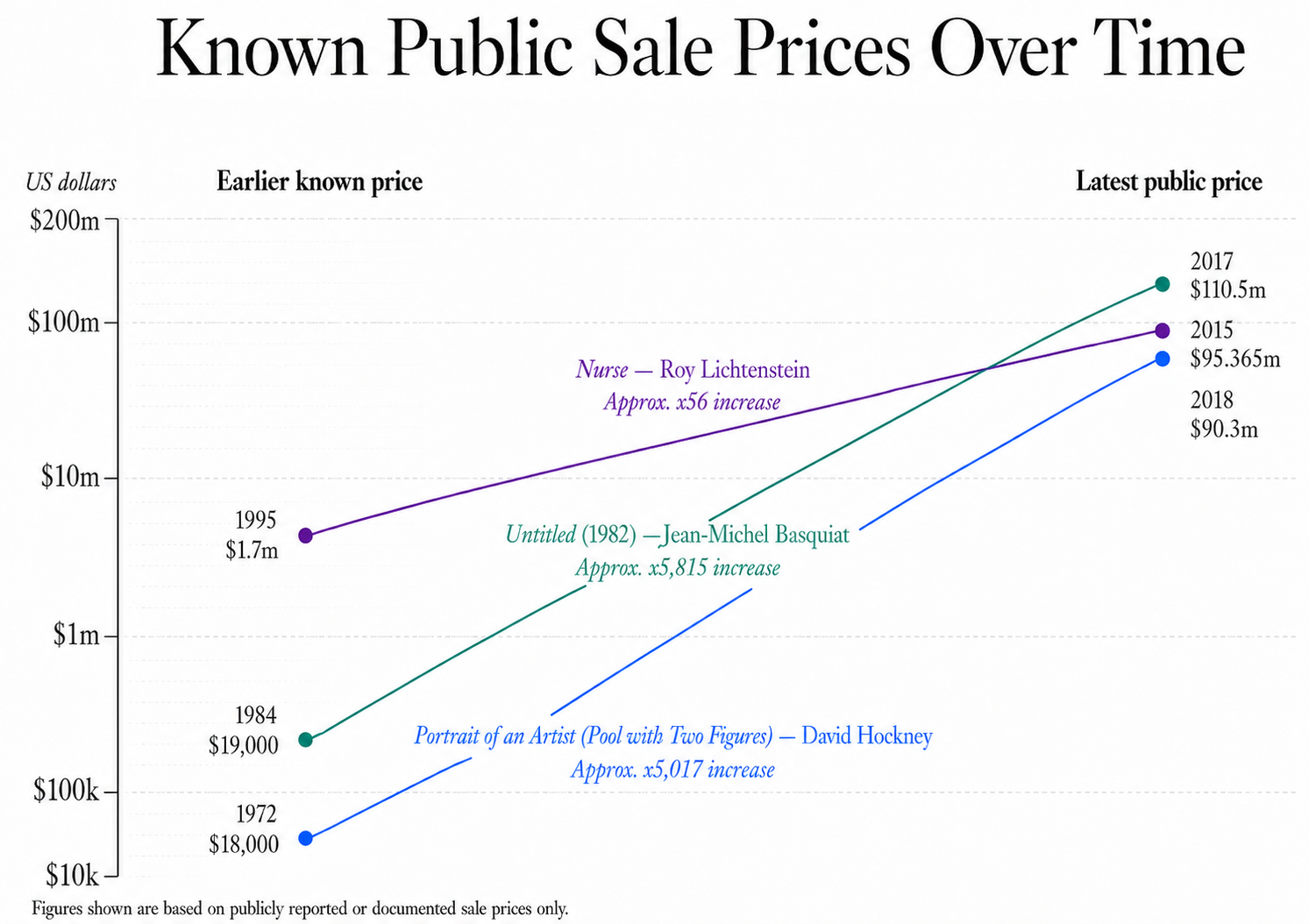
Source image: Velaras (Figures from Christie's, Sotheby's, and Christie's)
Some blue chip works have appreciated significantly over time. Public sale histories for works by Hockney, Lichtenstein, and Basquiat show how certain museum-quality examples can move from relatively modest earlier prices to landmark auction results.
Even so, these outcomes should not be read as guarantees. They are examples of what can occur when an artist’s reputation, the work’s importance, scarcity, provenance, and demand align over time.
A more disciplined approach recognizes that value is but one consideration among several. Strong acquisitions are supported by cultural and market logic. A strong acquisition should be rewarding to live with, credible within art history, and carefully evaluated before any long-term decision is made.
How to Approach Buying Blue Chip Art
A well-considered acquisition process should begin with context rather than availability. Context should focus on what pieces or artists to consider, why their work matters, and whether the terms are appropriate. Below is a general approach to buying blue chip art with that important context in mind:
Define the area of interest
You should begin this process by defining the area of interest. This may be a period, movement, artist, medium, or collecting objective. For example, Post-War art is a particularly meaningful area because it includes many of the mature artists and historically relevant practices that continue to shape serious collections.
Evaluate the work in context
After narrowing your search down to a few options, research and evaluate them in-depth. This should look beyond hard data and towards areas such as quality, condition, authenticity, provenance, exhibition history, and publication records. These works should never be assessed in isolation but in relation to the artist, their broader practice, and comparable examples.
Understand the route to access
It’s also important to consider access. The most relevant works are not always broadly visible or available through open channels. Significant opportunities may emerge through private channels, long-standing relationships, and traditional or non-traditional routes. In this market, access is often shaped by credibility, timing, and the ability to act with informed conviction.
Assess value with discipline
Value should be assessed with discipline. This involves more than comparing recent sales. It requires judgment around quality, rarity, context, and the strength of demand for the particular type of work under consideration.
Blue Chip Art and Post-War Collecting
Post-War art remains one of the most significant areas for blue chip collecting. It includes many of the movements, materials, and ideas that shaped the second half of the 20th century and continue to influence contemporary visual culture.
The category is broad, but its strongest works tend to share a sense of historical consequence. They reflect changes in abstraction, figuration, image-making, materiality, politics, identity, and the relationship between art and everyday life.
For collectors, Post-War art offers both depth and range. It includes internationally recognized market become clearer through renewed scholarship, institutional attention, or changing historical perspectives.
This is where judgment becomes particularly important. A work may be by a recognized artist, but the best opportunities often depend on understanding relative quality. Which period matters most? Which works are rarely available? Which examples remain underappreciated? Which pieces have the capacity to support a collection over time? In this area of the market, informed selection is incredibly important.
The Velaras Approach to Blue Chip Art
Velaras approaches blue chip art through disciplined judgment rather than inventory-led selection. The focus is not on abundance, but on identifying significant works with enduring quality.
This requires experience, access, and structure:
Experience provides the context to recognize quality where others may see only uncertainty.
Access expands the range of possible opportunities beyond what is broadly visible.
Structure helps ensure that decisions are made with discipline, independence, and alignment.
Curated Connoisseurship is Velaras’ approach to selection. It is grounded in continuous evaluation, long-standing global relationships, and a commitment to works that are culturally meaningful, historically relevant, and rewarding to live with.
For discerning buyers, this offers a more considered way to acquire art. It allows decisions to be shaped by context rather than impulse, by quality rather than availability, and by long-term significance rather than short-term attention.
A More Considered Way to Acquire Blue Chip Art
Blue chip art can offer cultural significance, established quality, and enduring value, but only when approached with care. The most meaningful acquisitions are shaped by judgment, access, and a clear understanding of why a work matters.
For buyers seeking significant Post-War art, Velaras provides a more considered acquisition framework that is grounded in experience, independent sourcing, and disciplined evaluation. Find out how Velaras can help you make enduring art acquisitions, or discover our available works by reaching out to us today.
Frequently Asked Questions
-
Blue chip art refers to work by established artists whose cultural importance, institutional recognition, and market demand have been demonstrated over time.
-
A blue chip artist is usually recognised through a combination of museum representation, significant exhibitions, art-historical research, sustained collector demand, and an established position within the wider market.
-
Blue chip art is often high-value, but prices vary significantly depending on the artist, medium, date, scale, rarity, condition, provenance, and importance of the work.
-
No artwork is risk-free. Blue chip art may have a more established market than speculative areas, but values can change, and liquidity is not guaranteed. Careful evaluation remains essential.
-
Blue chip art refers to established artists whose reputations have been tested over time. Red chip art usually refers to artists whose markets have risen quickly and are still being tested.
-
No, a blue chip name does not automatically make a work significant. Period, quality, condition, provenance, rarity, and relevance within the artist’s practice all matter.
-
A buyer should begin with context. This means understanding the artist, the work’s significance, its condition, provenance, market history, and fit within a broader collecting objective before making an acquisition decision.
Ultimately, Velaras’ approach is to ground decisions not in forecasting what may happen, but in understanding what already has.