Art as an Investment
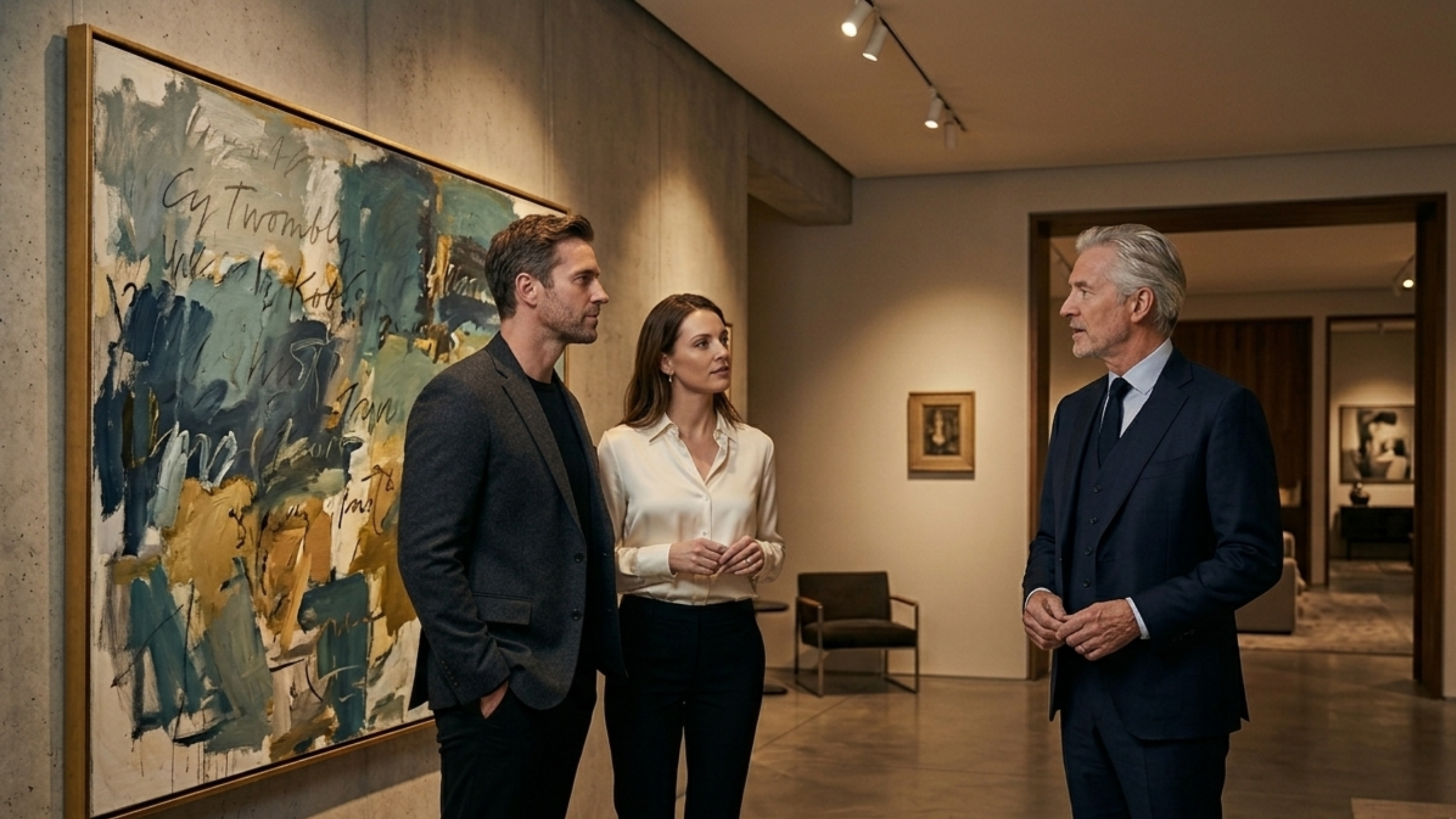
Acquiring art has long appealed to buyers who recognize value beyond financial terms. A major work can carry cultural weight, shape the character of a space, and become part of a broader personal or family legacy. In many cases, investment-grade art can also retain, or meaningfully increase, its market value over time. However, treating art as an investment requires care.
Art is not a conventional asset class. It is not traded on a central exchange, pricing is often opaque, and reliable information is not evenly distributed across the market. For this reason, art should not be acquired on short-term momentum alone.
The more important question is what kind of art investing merits long-term ownership, and what judgment is required to acquire it well. When quality, context, access, information, and discipline are present, art can offer something distinct: cultural significance, enduring value, a considered form of personal expression, and the reward of living with the work.
What Does It Mean to Treat Art as an Investment?
Treating art as an investment requires a nuanced approach to artists and their work. That means looking beyond whether a given work will appreciate over time and toward identifying qualities that will remain relevant, desirable, and defensible over the years.
Significance before speculation: Much of the secondary market is shaped by availability, visibility, and preference. A work may be visually appealing, well presented, or associated with a recognized name, yet still lack the depth required for long-term significance.
Variables that shape long-term value: Art investment should be less concerned with broad market participation and more with refining a disciplined selection process. Unlike a standardized asset, the variables in art investment can’t be easily reduced to a single data point. They require context and an ability to distinguish between available works and those that merit long-term consideration.
Why Art Can Be an Appealing Long-Term Investment
Although it requires a more nuanced approach, art can be appealing as a long-term investment because it holds value in different ways. A historically relevant work may be financially important, but it can also offer intellectual, cultural, and personal rewards that don’t exist in traditional asset classes.
A tangible asset with cultural depth
Art is a tangible asset, but not a purely functional one. It can offer value as an aesthetic to be viewed and exhibited, shared, and passed on. For some art collectors and buyers, this layered value is central to art’s appeal as a long-term acquisition.
Value beyond ownership
The experience of owning art is also distinct. A painting or sculpture does not sit apart from daily life in the way many financial assets do. Instead, it becomes part of an environment, a conversation, and, over time, a personal history.
Where the Art World Differs From Standardized Asset Classes
Art is quite different from traditional investments, requiring a grounded understanding of pricing, access to information, and the factors that distinguish one work from another. These differences don’t diminish the appeal of investment, but they do change the decision-making process.
Opaque pricing: There is no central marketplace where all works are listed, priced, and traded with full transparency. Many important transactions occur privately, through galleries, dealers, advisors, collectors, and long-standing relationships. This means value is often shaped by information that is not fully visible to the wider market.
Uneven access to information: The art market operates with a high degree of information asymmetry. Some participants have access to deeper knowledge of recent transactions, private availability, institutional interest, forthcoming exhibitions, and collector demand. Others are limited to what is publicly visible.
Variation between works: Pricing is highly specific to the individual work. Looking at a broad average for an artist can be misleading, as the value depends on the individual work. Variables such as period, medium, publication history, and provenance can all have a material influence.
Liquidity and time horizon: Unlike more conventional assets, art cannot always be sold quickly or through a single transparent marketplace. This is why art should generally be approached with a long-term horizon.
What Gives an Art Collection Enduring Value?
Enduring value in art rarely stems from visibility alone. It is shaped by the relationship between an artist’s historical significance, the quality of the specific work, and the depth of demand among informed buyers.
Artist significance
An artist's significance is an important starting point when identifying enduring works. Mature, established artists (such as blue-chip artists) often provide a stronger foundation for evaluation because their work has been tested over time. Scholarship, institutional recognition, exhibition history, and market participation all help create context around the impact of the artist and their work.
Significance is often shaped by whether the artist, or a particular body of work, advanced the visual language of its time. Pioneering technique, conceptual originality, and meaningful influence all strengthen long-term relevance. Work that is largely derivative or repeats established ideas without distinction is less likely to carry the same enduring importance.
Quality within the body of work
Not every work by a significant artist is equally important. Some works sit at the centre of an artist’s practice, while others are more peripheral. Some showcase defining periods, subjects, or methods; others may be less resolved or less representative of an artist’s best-known styles.
Provenance, condition, and rarity
Provenance, exhibition history, publication records, condition, and authenticity can all materially influence value. Rarity also matters, but only when supported by quality; scarcity alone is not the same as significance.
Institutional and collector demand
Institutional recognition can provide an important signal of an artist’s place within art history and culture. Exhibitions, acquisitions, scholarly attention, and critical reassessment may all contribute to long-term relevance.
Institutional recognition is another important factor. Exhibitions or acquisitions by major institutions such as the MoMA, Tate, or the Guggenheim can provide meaningful validation, particularly when they place the artist or work within a broader art-historical context. Collector demand also matters, but it should be assessed with care.
Enduring value, then, is the result of different variables working together. Importantly, it doesn’t come from trends, promotion, or broad visibility. Instead, it is recognized through informed judgment.
The Long-Term Relevance of Post-War Art Collecting
Post-War art holds a commanding position in the modern and contemporary art market. Many of its leading artists—including Cy Twombly, Willem de Kooning, and Mark Rothko—have shaped and guided the modern visual language of the second half of the twentieth century. Their significance lies beyond recognition, but in the extent to which their work pushed new techniques, materials, and modes of abstraction forward.
The art-historical importance can be seen when looking at the scholarly, institutional, and collector interest around these artists. Major works from Rothko and Pollock demonstrate the market's high demand for rare, high-quality examples by artists whose influence has been tested over the years. Rothko's No. 7 sold for $82.5 million at Sotheby's in 2021, while Pollock's auction record was reported at $62.1 million for Number 17, 1951 in 2021.
A category with historical depth
Post-War art offers meaningful depth for buyers looking for long-term acquisitions. Many Post-War artists have established bodies of work, clearer market histories, and decades of critical engagement.
These qualities provide a more established basis for evaluation than categories where reputation, demand, and institutional support remain comparatively unformed.
Mature artists and established quality
Post-War art is often recognizable, but for many, that isn’t the main driver behind its appeal. It is a category of art that contains works with rich cultural and historical importance, supported by a more developed body of scholarship and market activity.
Artist recognition is not enough
An artist’s recognition doesn’t remove the need to assess the work. Within any mature market, you will find that quality varies, and Post-War art is no different. Finding the best opportunities typically requires careful comparison, informed sourcing, and the ability to assess whether a work has distinction within its category.
From this context, connoisseurship—the ability to judge art based on long-term relevance, significance, and quality—is key. It allows buyers to move beyond the surface of reputation and consider the more important question: Does this work hold enough quality, context, and relevance to justify long-term ownership?
The Risks of Treating Art Investment Too Speculatively
Art can hold long-term appeal when acquired with care, but risk increases when buyers are led by momentum rather than judgment. Established artists and historically tested works often provide a clearer basis for evaluation, while less mature markets require greater caution.
When visibility moves ahead of institutional recognition, critical context, or sustained collector demand, buyers can be exposed to risk that is difficult to assess in the moment. Key risks to be mindful of include:
Market attention: An artist, movement, or category may experience rapid visibility, but short-term attention does not always translate into lasting relevance.
Shifting relevance: Works acquired primarily because they appear current, scarce, or widely discussed may not retain the same importance once the market moves on.
Price requires context: Because pricing is often opaque and information is unevenly distributed, it can be difficult to determine whether a price is appropriate. Without sufficient context, buyers may pay for availability rather than quality.
Access and discernment: Being offered a work does not necessarily mean it represents the best option available. It may simply reflect the priorities of a particular seller, gallery, advisor, or channel.
Liquidity: Art is not always easy to sell quickly. The appropriate buyer pool for a significant work may be narrow, and a strong outcome often depends on timing, discretion, and the right route to market.
These considerations do not diminish art’s appeal as a long-term acquisition. They reinforce the need for discipline. The objective is not to follow momentum, but to acquire works whose quality and relevance can be understood beyond a particular market moment.
The Foundations of Confident Art Acquisition
Successful art acquisition depends on the interaction of access, information, and judgment. Without these foundations, it can be incredibly difficult to identify, source, or make informed art acquisitions.
Access shapes the opportunity set
The most enduring and significant works are rarely publicly available. Many are placed privately, shared selectively, or offered first through long-standing relationships.
Access in the art market is often shaped by an informal hierarchy of trust, credibility, and buying history. Priority access can take years to establish and is often reserved for those with proven relationships, demonstrated commitment, or the ability to transact decisively at a meaningful level.
Without access to these channels, buyers may only see a narrow portion of the market. The challenge is less about finding art to invest in than to gain access to the right works to consider.
Information creates context
Having the right information about the work helps to determine a fair valuation, how it compares to similar examples, and whether other factors may influence its long-term value.
This can include assessing recent private transactions, institutional activity, provenance, and long-term demand patterns. Transparency is limited in this type of market, so context is important.
Judgment brings clarity
Judgment is the bridge between access and information. It determines whether an opportunity is worth pursuing, whether a price is defensible, and whether the work has the quality to support long-term ownership.
These capabilities are not easy to replicate. They are developed through sustained exposure to works, artists, institutions, collectors, dealers, and market activity. Over time, this experience forms the basis for conviction.
For buyers who do not wish to become art-world insiders themselves, the challenge is to access this depth of perspective in a structure that supports clear, independent decision-making. Working with Velaras offers buyers these insights and perspectives without investing the time and resources necessary for informed art acquisition.
How Structure and Incentives Shape Acquisition Outcomes
The channels and structures used to acquire art influence outcomes. Galleries, auction houses, advisors, dealers, and acquisition partners can all provide access to art, but their incentives are not always the same as the buyer’s and often conflict with them. Commercial priorities, inventory positions, commissions, and transaction-led models can shape what is shown, how opportunities are framed, and how decisions are made.
Independent sourcing preserves objectivity
Independence is important because it broadens the field of consideration. If sourcing is limited to inventory that is available or existing commercial obligations, then selection is guided by constraint rather than quality. Opting for a more independent structure allows works to be evaluated on their own merits, such as quality, value, or relevance.
Alignment creates greater confidence
Alignment is another important area where structure and incentives can govern acquisition outcomes. If the party guiding the acquisition has direct financial exposure, such as a payment from the sale, then the decision-making dynamic shifts.
Choice supports considered decisions
For some buyers, choice is an important part of confidence. The ability to live with a work before making a long-term acquisition decision, or to acquire through a tailored structure, can reduce upfront commitment and allow the decision to develop with time and context.
How to Approach Art as a Long-Term Acquisition
A considered approach begins with the work itself. Before questions of price or availability, the buyer must understand whether the work has the quality, context, and significance to merit long-term ownership.
Begin with significance
Although it is easy to focus on the availability or aesthetics of a particular piece, these factors will not suffice for a suitable art investment strategy. The more pressing areas to look at are the quality, context, and significance of long-term ownership of the work.
Assess the specific work, not the artist
When buying art with long-term acquisition in mind, look beyond the artist’s name alone. Consider the artist’s historical relevance and the role of the specific work within their wider practice. The question is whether the work belongs to a particularly meaningful period, whether its condition and provenance are sound, and whether the price aligns with comparable examples.
Glean insights from public auction records
Public auction records can provide useful evidence of secondary-market activity and collector demand. They may help indicate how works by a particular artist, period, or series have been received in the market. However, auction results should be interpreted carefully. Price can be shaped by rarity, condition, provenance, scale, subject, timing, estimate strategy, and the presence of competing bidders. A strong auction result may support relevance, but it does not replace careful assessment of the individual work.
Take a long-term view
Investment art is a long-term approach that requires patience. The strongest acquisition may not be the most visible one, which often means working through private sourcing, careful evaluation, or being willing to wait for a work that meets the right standards.
The Velaras Perspective
Velaras was created for discerning buyers who recognize the significance of art, but who may not wish to navigate the art market alone. We provide clients with a seamless approach to acquiring museum-quality Post-War art across various movements, artists, and price points.
Curated Connoisseurship
Our approach is grounded in Curated Connoisseurship: a disciplined method of identifying and acquiring Post-War art through experience, objectivity, and continuous evaluation.
We focus on mature artists, historically relevant works, and acquisition decisions shaped by quality rather than availability.
Independent sourcing
Through independent sourcing and long-standing global relationships, Velaras gives clients access to opportunities that are often not broadly available.
This allows works to be considered across traditional and non-traditional channels, with selection guided by context, value, and fit.
Alternative Acquisition
Our Alternative Acquisition model is designed to provide confidence and optionality. Clients can engage with significant works through tailored structures, including the ability to live with works before making long-term acquisition decisions where appropriate.
This reflects a central belief at Velaras: art should be more than aesthetic decoration, offering cultural, personal, and enduring value.
Art Acquired With Judgment Endures
Art can hold meaningful long-term investment appeal, but only when acquired with the discipline the category requires. The strongest acquisitions are grounded in quality, context, access, information, and judgment.
For discerning buyers, the opportunity lies in recognizing works whose significance extends beyond the immediate market. These are works that can carry cultural weight, reward sustained engagement, and retain relevance over time.
Successful art acquisitions must first be understood, considered, and chosen with conviction. At Velaras, we help clients reach that conviction through disciplined judgement, independent sourcing, and access to significant works of enduring quality. To learn more or start investing in art with confidence, please contact Velaras today.
Ultimately, Velaras’ approach is to ground decisions not in forecasting what may happen, but in understanding what already has.